
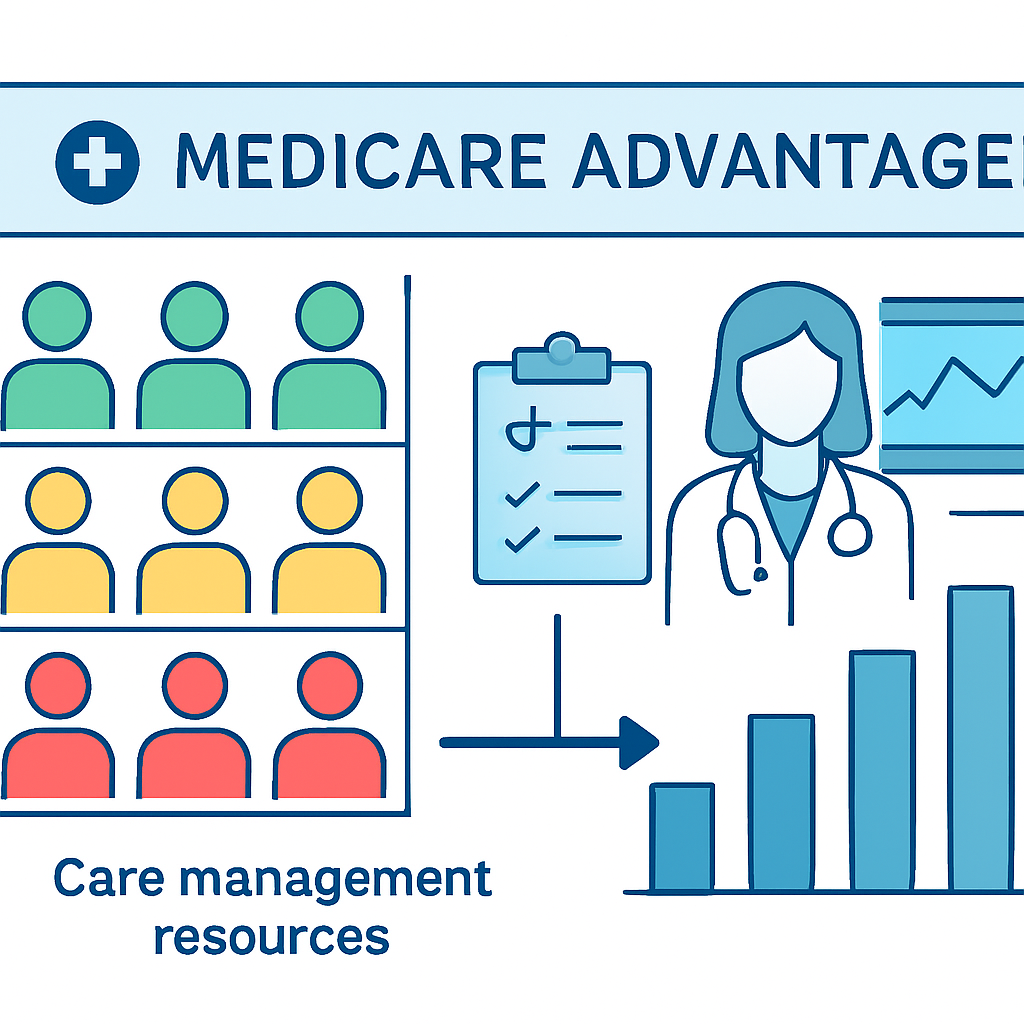
The Medicare Advantage Risk Management Challenge
Medicare Advantage plans face a fundamental challenge: how to identify which of their millions of attributed members need proactive intervention before costly acute events occur.
The financial stakes are enormous. A single 30-day readmission costs $15,000-$25,000 on average. For plans with 100,000+ members, even modest improvements in readmission rates translate to millions in avoided costs.
Traditional Approaches to Member Risk Stratification
HCC-Based Risk Scoring
Most MA plans use Hierarchical Condition Category (HCC) scores as their primary stratification tool. HCC predicts annual costs, not acute events. A member with multiple chronic conditions may have a high HCC score but low near-term hospitalization risk if their conditions are well-managed.
Claims Lag Problem
Traditional risk models rely on claims data, which can be 30-90 days old by the time it's processed. By the time claims reveal a concerning pattern, the acute event may have already occurred.
Generic "Rising Risk" Algorithms
Many plans use proprietary "rising risk" algorithms that flag members showing concerning trends. These often have poor specificity, identifying thousands of members as "rising risk" without clear prioritization.
The Role of 30-Day Readmission Prediction
Readmission prediction fills a critical gap in the MA risk stratification toolkit:
Near-Term Actionability
Unlike annual cost predictions, 30-day readmission risk identifies members who need intervention now—not sometime in the next year. This enables targeted outreach while there's still time to make a difference.
Event-Specific Focus
Readmissions are concrete events with clear intervention opportunities:
Generic "rising risk" doesn't provide this clarity.
Resource Prioritization
Care management teams have finite capacity. Validated readmission prediction helps answer: "Which members returning home from the hospital need our attention most urgently?"
Implementing Readmission Prediction in MA Operations
Data Sources
MA plans have unique data assets for readmission prediction:
Claims data: Diagnoses, procedures, utilization history, medication fills
ADT feeds: Real-time admission, discharge, transfer notifications from network hospitals
Care management records: Prior interventions, engagement history, care plan compliance
Social determinant data: ZIP code-level indices, transportation access, food security
Marqi Index can incorporate all these sources for payer-specific risk stratification.
Workflow Integration
Inpatient notification: When a member is admitted, calculate baseline readmission risk. Flag high-risk members for concurrent review.
Discharge notification: Update risk score with discharge data. Trigger immediate care management outreach for highest-risk members.
Post-discharge period: Monitor for early warning signs (missed follow-up, unfilled prescriptions) and update risk dynamically.
Intervention Tiering
Risk scores should drive differentiated interventions:
| Risk Level | Intervention | Timing |
|------------|--------------|--------|
| Very High (>40%) | RN care manager call within 24 hours, home visit if indicated | Day 1-2 |
| High (25-40%) | Care coordinator call within 48 hours, medication reconciliation | Day 2-3 |
| Moderate (15-25%) | Automated IVR follow-up, pharmacy outreach if fills missed | Day 3-7 |
| Low (<15%) | Standard member portal messaging | Day 7+ |
Performance Measurement
Track intervention effectiveness by risk stratum:
The Financial Model
Let's model the impact for a 200,000-member MA plan:
Assumptions:
Results:
Integration with Existing Programs
Readmission prediction complements other MA risk management programs:
Complex Case Management: Use readmission risk as one factor in identifying members for intensive CCM enrollment.
Disease Management: High-risk discharged members with CHF, COPD, or diabetes can be prioritized for disease-specific programs.
Pharmacy Services: Pharmacist outreach can focus on high-risk members with medication complexity.
Social Services: Members with high risk driven by social factors can be connected with community resources.
Vendor Selection Considerations for MA Plans
When evaluating readmission prediction solutions, MA plans should consider:
Data flexibility: Can the vendor work with your existing data feeds, or do they require new integrations?
Population coverage: Is the model validated on Medicare populations specifically?
Payer-specific features: Can risk be stratified by plan, product, or network?
Scalability: Can the solution handle your full member population in near-real-time?
Compliance: Does the vendor meet HIPAA, HITRUST, and other security requirements?
Conclusion
Medicare Advantage plans need better tools for identifying which members need intervention most urgently. Traditional HCC scoring and generic rising-risk algorithms leave gaps that validated readmission prediction can fill.
By deploying calibrated 30-day risk prediction with integrated care management workflows, MA plans can reduce readmissions, improve member outcomes, and generate significant medical cost savings.
Marqi Index is purpose-built for payer deployments, with flexible data integration, payer-specific validation, and scalable architecture. We'd welcome the opportunity to discuss how validated readmission prediction could enhance your member risk stratification program.