
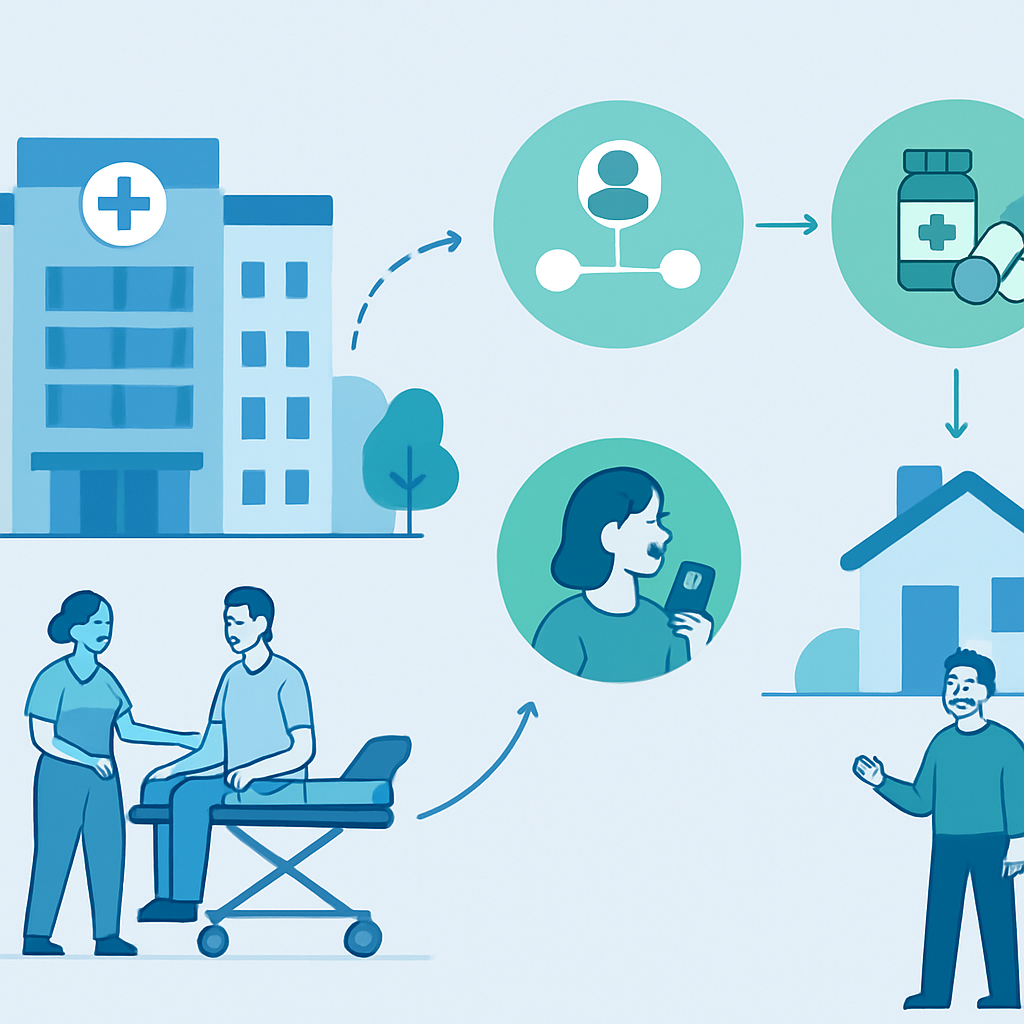
The HRRP Landscape in 2024
The Hospital Readmissions Reduction Program has been in effect for over a decade, yet many health systems still struggle with penalties. In FY2024, CMS penalized 2,273 hospitals, with maximum penalties reaching 3% of Medicare payments.
But the financial penalty is only part of the story. Readmissions represent care fragmentation, patient suffering, and missed opportunities for better outcomes. Leading health systems have moved beyond penalty avoidance to genuine quality improvement.
Why Traditional Approaches Fall Short
The "Transition of Care" Checkbox Approach
Many hospitals implemented readmission reduction programs that focus on process metrics:
These processes matter, but treating them as checkboxes rather than meaningful interventions often yields disappointing results. A scheduled appointment doesn't help if the patient can't get transportation.
The Blanket Intervention Problem
Another common approach: apply the same interventions to all patients. Everyone gets a follow-up call. Everyone gets a pharmacist review. Everyone gets printed discharge instructions.
This approach wastes resources on low-risk patients while spreading care management thin across the population. The highest-risk patients may receive the same interventions as someone with minimal readmission risk.
Relying on Outdated Risk Tools
As we've discussed in other articles, many health systems still use LACE or similar first-generation risk scores. With AUCs in the 0.60-0.68 range, these tools miss many high-risk patients while flagging low-risk ones, undermining intervention targeting.
The Strategic Approach to Readmission Reduction
1. Risk Stratification with Validated AI
The foundation of effective readmission reduction is accurately identifying who needs help most. Marqi Index achieves an AUC of 0.81, meaning far fewer high-risk patients are missed compared to LACE.
But discrimination is only half the story. Calibrated risk predictions allow health systems to:
2. Intervention Matching
Not every high-risk patient needs the same intervention. Risk drivers vary:
High-risk due to medication complexity → Pharmacist-led medication review and teach-back
High-risk due to social determinants → Social work referral and community health worker engagement
High-risk due to disease severity → Home health services and closer clinical follow-up
High-risk due to poor health literacy → Simplified instructions and caregiver involvement
Modern AI can identify not just who is at risk, but why—enabling targeted interventions that address root causes.
3. Real-Time Workflow Integration
Risk scores calculated after discharge are too late. Leading health systems integrate risk prediction into discharge planning workflows:
Marqi Index integrates via SMART on FHIR apps, Epic BPA integrations, or HL7 feeds to deliver predictions where and when clinicians need them.
4. Performance Monitoring and Feedback
Readmission reduction requires ongoing measurement:
Model performance monitoring: Is the AI still accurate as patient populations change?
Intervention effectiveness: Which interventions work best for which patient segments?
Resource utilization: Are care management resources reaching the right patients?
Health systems with mature programs conduct monthly reviews of predicted vs. observed readmission rates, intervention completion rates, and cost per averted readmission.
The Financial Case for AI-Driven Readmission Reduction
Let's do the math for a mid-sized health system:
Baseline metrics:
With validated AI and targeted interventions:
The ROI typically exceeds 10:1 for organizations that implement AI-driven readmission programs effectively.
Implementation Roadmap
Phase 1: Foundation (Months 1-3)
Phase 2: Intervention Optimization (Months 4-6)
Phase 3: Continuous Improvement (Ongoing)
Conclusion
The HRRP penalty is a symptom, not the disease. Health systems that focus solely on penalty avoidance often implement surface-level programs that don't meaningfully improve patient outcomes.
Effective readmission reduction requires validated risk prediction, targeted interventions, workflow integration, and continuous measurement. The technology exists—the question is whether health systems are willing to move beyond checkbox compliance to genuine quality improvement.
The financial rewards follow the clinical ones. Health systems that reduce readmissions effectively see cost savings that far exceed any penalty they might have faced.